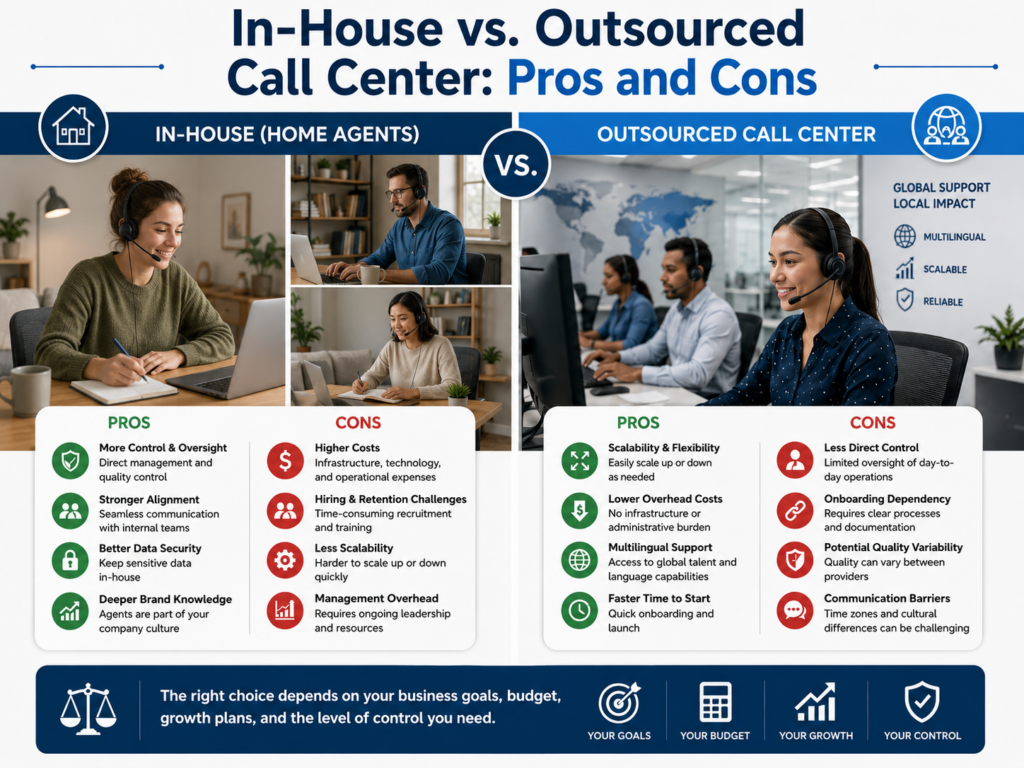
Consider a sales manager at a mid-sized German manufacturing company. Revenue is growing, but the internal team cannot keep up with inbound inquiries from France, Spain, and the UK. Hiring locally for each language would take months and stretch the budget. The question is not whether customer communication matters — it is whether the right model is in-house, outsourced, or a combination of both. This is a decision that affects cost, quality, and operational reliability.
Key Takeaways
- In-house call centers give you direct control but require significant fixed investment in hiring, training, and infrastructure.
- Outsourced call centers provide flexible capacity and multilingual support without long hiring cycles.
- Cost comparisons must account for hidden expenses such as recruitment, software licences, and management time.
- The best approach for many European businesses is a hybrid model that keeps core functions internal and outsources overflow or language-specific campaigns.
When a business compares an in-house vs outsourced call center, the conversation usually starts with cost per call. But the real difference runs deeper. Understanding the in-house vs outsourced call center pros and cons means looking at staffing flexibility, management overhead, quality control, reporting standards, and the ability to support multiple European markets without duplicating teams. This helps business owners, sales managers, and operations managers make a decision that fits their actual operational reality rather than a generic recommendation.
In-House vs. Outsourced Call Center: Pros and Cons — What This Decision Means for Your Operations
Most comparisons simplify the choice into a budget question. In practice, the decision between running a call center internally or working with an external partner touches multiple operational layers. The right answer depends on call volume stability, language coverage needs, internal management bandwidth, and the level of process maturity your business already has.
Scale and Volume Predictability
In-house teams work best when call volume is predictable and stable. If your business receives a consistent number of inbound calls per week and knows the staffing requirement weeks in advance, building an internal team is manageable. When volume fluctuates — seasonal peaks, campaign-driven outbound waves, or growth in new markets — an in-house team either sits idle during slow periods or struggles to keep up during surges. Outsourced operations absorb this variation more easily because they manage staffing across multiple clients and campaigns.
Cost Structure and Budget Impact
An in-house call center involves fixed costs that continue regardless of call volume: salaries, social contributions, office space, hardware, phone systems, CRM licences, quality monitoring tools, and management salaries. An outsourced model converts most of these into variable costs tied to actual activity. The trade-off is that per-hour or per-call rates for outsourcing include the partner’s margin, so at very high volumes the per-unit cost of an in-house team can be lower.
Management Overhead and Attention
Running a call center internally requires at least one dedicated manager responsible for scheduling, coaching, quality monitoring, reporting, and escalation handling. In smaller businesses, this person is often a sales manager or operations lead who already has a full workload. Outsourcing shifts the day-to-day management to the partner while keeping strategic oversight and campaign direction with your team. The question is whether your internal team has the bandwidth to run a call centre operation or whether their time is better spent on core business activities.
In-House Call Center: Where It Works Best
An in-house call center can be the right choice when control over every customer interaction matters more than flexibility or speed of setup. There are specific scenarios where building internal capacity is the stronger option.
When Full Control Is Non-Negotiable
If your product or service requires highly specialised product knowledge, regulatory compliance handling, or complex technical support that would take months to train an external team on, keeping calls in-house makes sense. The same applies when brand voice consistency is critical and cannot be delegated. In these cases, the investment in internal hiring and training is justified because the alternative — trying to transfer deep product expertise externally — creates too much risk.
When You Already Have the Infrastructure
Businesses that already operate a sales or support team with spare capacity, existing CRM setup, and unused phone system licences are closer to a cost-effective in-house model. The incremental cost of adding more agents to an existing setup is lower than switching to an external provider. The danger is assuming spare capacity today means spare capacity six months from now.
Hidden Costs of Running In-House
Salary costs are visible. What is less visible is the time spent interviewing candidates who leave within three months, the hours managers spend on shift scheduling, the cost of software tools that need annual renewal, and the impact of a sick day on a five-person team where every person counts. For smaller teams, one absence can reduce capacity by twenty percent. That is an operational risk that does not show up in a budget spreadsheet but affects customer experience directly.
Outsourced Call Center: When External Capacity Makes Sense
Outsourcing is not a surrender of control. It is a decision to buy operational capacity, process expertise, and flexibility that would be expensive and slow to build internally. For many European businesses, the case for outsourcing becomes clear when language coverage, speed of setup, or volume variability are factors.
Scaling Without Hiring Cycles
Adding an agent in an outsourced call centre can happen in weeks rather than months. The partner already has the recruitment pipeline, training framework, quality processes, and technology stack in place. For a business launching a campaign in a new market or handling a seasonal spike, this speed advantage is often the deciding factor. The alternative — advertising, interviewing, training, and ramping up internal agents — takes twelve to sixteen weeks in most European labour markets.
Multilingual Capability on Demand
Setting up an in-house team that covers German, French, Spanish, Italian, Dutch, and Swedish would require multiple hiring processes, language-specific training, and enough call volume in each language to justify dedicated staff. An outsourced multilingual call center spreads language coverage across multiple clients, making it viable to support languages where your business might only receive twenty or thirty calls per day. This is particularly relevant for companies operating across the European market.
Reporting and Process Standards
A professional outsourcing partner brings established reporting cadences, quality monitoring frameworks, escalation rules, and CRM discipline that would take months to develop internally. The reporting structure — daily call summaries, weekly campaign reviews, monthly performance analysis — becomes operational from day one rather than being built incrementally. For businesses that do not already have these processes, outsourcing provides a jump in operational maturity.
Decision Table: Matching Business Needs to Call Center Model
The table below compares key decision factors across in-house and outsourced models. Use it as a starting point for your own evaluation.
| Decision Factor | In-House Call Center | Outsourced Call Center |
|---|---|---|
| Call volume stability | Strong fit for stable, predictable volumes | Handles fluctuating and seasonal volumes well |
| Setup speed | 8–16 weeks for hiring and training | 2–4 weeks for campaign launch |
| Cost flexibility | Fixed costs regardless of volume | Variable costs tied to actual activity |
| Language coverage | Requires separate hires per language | Multi-language from established teams |
| Management effort | Dedicated internal manager needed | Strategic oversight only, no daily management |
| Quality control | Direct visibility into every call | Relies on partner’s monitoring and reporting |
| Technology investment | CRM, phone system, QA tools, licences | Included in partner infrastructure |
| Scalability | Limited by hiring capacity | Rapid up and down based on need |
Risks on Both Sides
Neither model is risk-free. Understanding the specific risks of each approach helps you build safeguards before problems appear rather than reacting to them.
Common Outsourcing Risks
The main risk is partner quality. A provider that does not invest in agent training, uses script-driven conversations without adaptation, or provides inconsistent reporting will damage your customer communication rather than improve it. The solution is thorough due diligence: requesting call samples, checking client references, reviewing quality monitoring processes, and starting with a small pilot campaign rather than a full transition. Another risk is data protection, especially when operating across European markets with GDPR requirements. A professional outsourcing partner should have clear data handling protocols and be transparent about their compliance measures.
Common In-House Risks
The main risk is fixed cost exposure. If call volume drops due to market conditions, campaign changes, or seasonality, the salary costs remain. The second risk is dependency on individual agents. In a small in-house team of three or four people, losing one agent means losing twenty-five to thirty-three percent of capacity. Replacement takes weeks. The third risk is stagnation — internal teams that do not receive regular coaching, script updates, or performance feedback tend to develop inconsistent quality over time simply because the internal manager has other responsibilities competing for attention.
How ITMC LTD Supports Companies Through This Decision
Making Outsourcing Work as an Operational Extension
ITMC LTD helps businesses that have decided to outsource some or all of their call center activity. The focus is not on selling a generic service, but on building a structured cooperation that fits the business’s specific communication needs, campaign requirements, and reporting expectations.
- Outbound and inbound call handling in multiple European languages from one operational team.
- Structured campaign setup with script development, call flow testing, and quality calibration before launch.
- Regular reporting cadence with daily summaries, weekly reviews, and monthly performance analysis.
- CRM-disciplined follow-up with clear handover notes and lead qualification criteria.
- Flexible capacity that scales with campaign activity without fixed staffing commitments.
Frequently Asked Questions
How do I know if my business is ready to outsource call center operations?
Your business is likely ready when call volume exceeds internal capacity, you need support in languages you cannot cover in-house, or management time spent on call center operations is pulling attention away from core business activities. A practical first step is to run a small pilot campaign with an outsourcing partner before committing to a larger transition.
What is the minimum call volume needed to justify outsourcing?
There is no strict minimum, but outsourcing becomes cost-effective when you need at least one full-time equivalent’s worth of call handling per week. For smaller volumes, a shared agent model where the partner allocates part-time capacity can work. The key is transparency about expected volume so the partner can staff appropriately.
Can I keep some call handling in-house while outsourcing the rest?
Yes. A hybrid model is common and usually effective. Many businesses keep complex technical support or high-value account management in-house while outsourcing overflow calls, multilingual campaigns, appointment setting, or outbound lead generation. The operational challenge is ensuring consistent handover processes so customers do not notice the difference.
How do I evaluate an outsourcing partner’s quality before signing a contract?
Request sample call recordings from similar campaigns. Ask about agent training hours, quality monitoring frequency, and escalation procedures. Check client references and ask specifically about what went wrong and how it was resolved. Start with a trial period of four to six weeks with clear success criteria rather than signing a long-term agreement immediately.
Will outsourcing reduce my control over customer communication?
Control depends on the setup, not the model. With clear campaign briefings, shared scripts, regular call listening, and weekly alignment calls, an outsourced team can operate with the same quality standards as an internal one. The control that decreases is day-to-day scheduling and individual agent management — the control that matters most, such as campaign direction and quality standards, remains with your team.
Final Thoughts
The in-house vs outsourced call center decision is not a question of which model is universally better. It is about which model fits your current operational reality. Businesses with stable volumes, deep product complexity, and existing infrastructure may find in-house works well. Businesses facing multilingual markets, volume fluctuations, or management bandwidth constraints often benefit from outsourcing. The smartest approach for many European companies is not a binary choice but a hybrid one — keeping core capabilities internal while using an external partner for the areas where speed, language coverage, or flexible capacity make the difference.
Sources
This article draws from business, sales, customer communication and outsourcing sources:
Work with ITMC LTD
If you are evaluating whether in-house or outsourced call center operations are right for your business, we can help. ITMC LTD provides multilingual call center and sales support services for European companies. We focus on clean process, structured reporting, and practical cooperation that feels like an operational extension of your own team — not a generic vendor relationship.