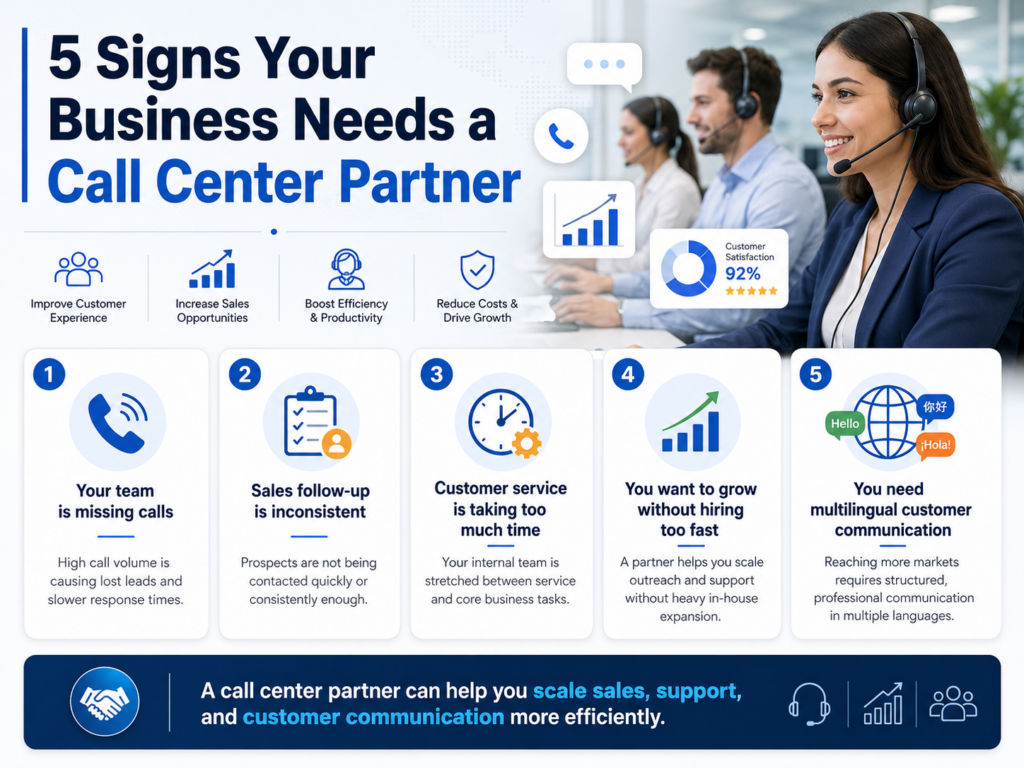
Quick Answer: A call center partner becomes useful when your business is missing calls, losing leads, delaying follow-up, struggling with multilingual communication or putting too much customer contact on internal teams. The right partner should support defined tasks, protect customer experience and provide structured reporting.
A call center partner can help when customer communication starts becoming too frequent, too important or too inconsistent to manage informally. For many companies, the signs appear gradually through missed calls, slow lead follow-up, overloaded staff, weak CRM notes and customers waiting too long for clear answers.
At first, these problems may look small. One enquiry is not called back. One customer waits longer than expected. One sales opportunity is not followed up properly. One employee handles calls between other tasks. Over time, these small gaps become visible in sales performance, customer service quality and management reporting.
The decision to work with a call center partner should not be based only on call volume. It should be based on whether your current setup can handle customer communication consistently, professionally and with enough structure.
Key Takeaways
- A call center partner makes sense when calls, leads and customer follow-up are no longer handled consistently.
- The need often becomes visible through missed calls, slow response times, weak CRM discipline and overloaded internal teams.
- Outsourcing works best when tasks, reporting, escalation rules and quality standards are clearly defined.
- The right partner should feel like an operational extension of the business, not a disconnected supplier.
Why Businesses Start Looking for a Call Center Partner
Businesses usually start looking for a call center partner when customer communication becomes difficult to control. This can happen during growth, after marketing campaigns, when entering new markets or when internal teams are already busy with sales, delivery, administration and customer support.
Phone-based communication requires time, attention and discipline. Calls must be answered. Leads must be contacted. Conversations must be documented. Customers must receive clear next steps. If this work is handled casually, quality becomes inconsistent.
A call center partner can support defined communication tasks such as outbound sales, lead generation, appointment setting, inbound support, customer service and CRM-related follow-up. The goal is not simply to add more callers. The goal is to create a more reliable process.
Reality check: Outsourcing does not fix unclear internal processes automatically. A call center partner can only perform well when the business provides clear instructions, realistic expectations, proper onboarding and agreed reporting standards.
Sign 1: Your Business Is Missing Calls or Responding Too Slowly
One of the clearest signs that your business needs a call center partner is slow response. If customers or prospects call and do not reach anyone, the business may lose trust before the conversation even starts.
This matters especially when calls come from website enquiries, paid campaigns, referrals, service questions or existing customers. When someone contacts the business, there is usually a reason. They may need information, support, a quote, an appointment or a decision. If the response is late, the customer may move on or become frustrated.
Why missed calls become a business problem
A missed call is not always just one missed conversation. It can represent a lost sales opportunity, an unresolved customer issue or a weaker impression of the business. The problem becomes bigger when nobody knows which calls were missed, who should follow up and whether the contact was handled later.
This often happens in growing businesses where internal staff answer calls between other responsibilities. Salespeople may be in meetings. Managers may be handling operations. Customer service staff may already be busy with active cases. In that situation, calls are answered only when someone has time.
Practical point: Before outsourcing, review how many calls are missed, how quickly enquiries are answered and whether every missed contact receives a documented follow-up. If this is not measured, the problem may already be larger than it appears.
Sign 2: Leads Are Coming In, But Follow-Up Is Inconsistent
Lead generation is only useful when leads are followed up properly. Many companies invest in websites, advertising, email campaigns or partner referrals, but then lose value because follow-up is too slow, too irregular or not documented clearly.
This is where a call center partner can provide structure. Leads can be contacted within an agreed process, qualified through defined questions and entered into the CRM with clear outcomes. This helps sales teams focus on better conversations instead of chasing every contact manually.
What inconsistent lead follow-up looks like
Inconsistent follow-up usually appears in simple but damaging ways. Some leads receive a call quickly, while others wait several days. Some prospects are contacted once and then forgotten. Some notes stay in personal inboxes instead of the CRM. Some leads are passed to sales without enough information.
The result is not only lower conversion. It also creates uncertainty inside the business. Management cannot see which campaigns are working, sales teams do not know which leads are serious, and prospects may feel that the company is not organised.
| Lead Follow-Up Problem | Operational Risk | How a Call Center Partner Can Help |
|---|---|---|
| Slow first contact | Prospects lose interest or contact competitors | Provide structured outbound follow-up within agreed timeframes |
| Poor qualification | Sales teams waste time on weak or unclear leads | Use defined qualification questions before handover |
| Weak CRM notes | Important details are lost after the call | Document call outcomes, objections and next steps |
| No follow-up rhythm | Potential customers are contacted once and then forgotten | Run planned callback and follow-up sequences |
Sign 3: Your Sales Team Is Spending Too Much Time on Basic Calling
Sales teams should spend time on serious conversations, qualified opportunities and closing work. If they are spending too much time calling unqualified contacts, confirming basic information or chasing meeting times, the sales process becomes less efficient.
This does not mean calling is unimportant. It means the calling work needs the right structure. Some calls are best handled by a dedicated team that can qualify interest, confirm details and prepare better handovers for sales.
When appointment setting becomes difficult internally
Appointment setting sounds simple from the outside, but it requires consistency. Contacts need to be reached, the message must be clear, objections must be handled, calendars must be coordinated and the sales team must receive useful context before the meeting.
If this work is done inconsistently, meetings may be booked with the wrong people or without enough qualification. That creates frustration for sales teams and a weaker experience for prospects.
A call center partner can support appointment setting by contacting defined target groups, checking basic fit, confirming interest and booking meetings according to agreed criteria. The goal is not just more meetings. The goal is better-prepared meetings.
Reality check: More booked appointments are not automatically better. If qualification is weak, the sales team may become busy but not more effective. Appointment setting should be judged by relevance, show-up quality and handover clarity.
Sign 4: Customer Service Is Becoming Too Much for Internal Staff
Customer service often becomes difficult when the same people who sell, deliver or manage operations also have to answer routine customer questions. At first, this may work. But as the customer base grows, the pressure increases.
Internal staff may start rushing calls, delaying responses or handling customer issues without proper documentation. This creates a risk for customer experience. Customers may receive different answers depending on who they speak to, or they may need to repeat the same information several times.
Why customer service needs structure
Good customer service is not only about being polite. It needs process. The team must know what can be answered directly, what needs escalation, what should be recorded and what follow-up is required.
A call center partner can help with defined customer service tasks such as inbound call handling, routine questions, customer updates, callback handling and CRM-related communication. This can reduce pressure on internal teams while keeping customer contact organised.
Practical point: Start by separating routine customer communication from complex internal decisions. A partner can often handle repeatable service tasks, while sensitive or high-value cases remain with your internal team.
Sign 5: You Need Multilingual Communication Across European Markets
Another sign your business may need a call center partner is language coverage. Many European businesses communicate across more than one market. A company may need German-speaking outreach, English customer communication, Norwegian or Swedish prospecting, or Spanish follow-up support.
Building this capacity internally can be difficult. It requires language skills, training, supervision, call quality control and market understanding. A multilingual call center partner can support companies that need structured communication across different European markets without building a full internal team for every language.
Why language alone is not enough
Language skills matter, but they are only one part of the work. Agents also need to understand the offer, the customer profile, the call objective and the limits of what they can promise. Without this context, even fluent communication can become weak.
For multilingual campaigns, the setup should include clear scripts, market notes, objection handling, pronunciation practice, escalation rules and reporting. The goal is professional communication, not just translation.
Internal Team or Call Center Partner: How to Decide
The decision is not always about replacing internal work. In many cases, the best setup is a combination. Internal teams keep control of strategy, complex cases and final sales decisions. The call center partner handles structured calling, qualification, follow-up and customer communication tasks.
This allows the business to protect quality while increasing capacity. The important point is to define responsibilities clearly. If both sides are unsure who owns which task, the customer experience can become worse instead of better.
| Question | Keep Internal | Consider a Partner |
|---|---|---|
| Is the task highly strategic or sensitive? | Usually yes | Only with strong onboarding and clear limits |
| Is the task repeatable and process-driven? | Possible, but may use internal time | Often suitable for call center support |
| Does the task require frequent follow-up? | Can become difficult at scale | Good fit when reporting is clear |
| Does the task require multilingual capacity? | Difficult if languages are not available internally | Strong reason to use a multilingual partner |
| Does management need better reporting? | Requires internal discipline | Can be built into the cooperation model |
What to Prepare Before Working With a Call Center Partner
Before starting cooperation, the business should prepare the basics. A call center partner does not need a perfect internal system, but it does need enough clarity to represent the business properly.
A practical starting point includes:
- a clear description of the service or offer
- defined target customers or existing customer groups
- call objectives and expected outcomes
- common questions and objections
- CRM access or reporting format
- escalation rules for complex cases
- quality standards for tone, documentation and follow-up
This setup protects both sides. The business keeps control of the message, and the external team knows what it is responsible for.
Common Risks When Choosing a Call Center Partner
Not every call center cooperation works well. Problems usually appear when the setup is vague, expectations are unrealistic or quality control is weak. A company should avoid choosing a partner only because it wants more calls at the lowest possible cost.
Useful questions to ask include:
- How will agents be trained before the campaign starts?
- How will call outcomes be documented?
- Who checks call quality?
- What happens when a customer asks something outside the script?
- How often will reports be shared?
- Which tasks stay internal?
The risk is not outsourcing itself, but poor setup. A good partner should be able to discuss process, reporting, handovers and quality before promising results.
How ITMC LTD Supports Companies as a Call Center Partner
ITMC LTD supports companies with multilingual call center services and outsourced sales support for European market communication. The cooperation can include outbound sales, lead generation, appointment setting, inbound support, customer service and CRM-related follow-up.
- Structured outbound calling for sales and lead generation campaigns
- Appointment setting with defined qualification and handover rules
- Inbound and customer service support for routine communication tasks
- Multilingual execution with reporting, training and practical campaign setup
How to Start Without Losing Control
A business does not need to outsource everything at once. In many cases, the safer approach is to start with one defined process. This could be lead follow-up, appointment setting, customer callbacks, inbound support overflow or a multilingual outreach campaign.
Starting small makes quality easier to control. The business can test the script, review reporting, adjust qualification rules and improve the handover process. Once the cooperation is working, the scope can be expanded carefully.
Practical point: A small pilot campaign with clear reporting is often more useful than a large unclear launch. It shows how the partner works, how customers respond and what needs to be improved before scaling.
FAQ
What is a call center partner?
A call center partner is an external team that supports a business with phone-based communication such as outbound sales, lead generation, appointment setting, inbound support, customer service and follow-up. The partner should work with clear processes, reporting and agreed responsibilities.
When does a business need a call center partner?
A business may need a call center partner when internal teams miss calls, respond slowly, struggle with lead follow-up, lack multilingual capacity or spend too much time on routine customer communication. The need is usually connected to consistency, capacity and process quality.
Can a call center partner help with lead generation?
Yes. A call center partner can support lead generation by contacting target groups, qualifying interest, documenting outcomes and passing better information to the sales team. The work should be based on clear criteria rather than random calling.
Is outsourcing customer service risky?
It can be risky if the setup is unclear. The risk is reduced when the business defines which tasks are outsourced, how agents are trained, when cases are escalated and how customer communication is documented.
Should a company outsource all calls at once?
Not necessarily. Many companies should start with one defined task, such as lead follow-up, appointment setting or overflow support. This makes it easier to test quality, adjust the process and build trust before expanding the cooperation.
Final Thoughts
A call center partner becomes useful when phone communication, lead follow-up or customer service can no longer be handled reliably by internal teams alone. The signs are usually practical: missed calls, delayed responses, weak CRM notes, overloaded staff and inconsistent customer contact.
The right partner should not only provide agents. It should provide structure. That means clear onboarding, defined responsibilities, call quality control, useful reporting and a practical understanding of how customer communication supports the business.
For many companies, the best first step is not a large outsourcing project. It is a focused cooperation around one important communication process. If that process improves, the business can then expand the partnership with more confidence.
Sources
This article draws from business, sales, customer communication and outsourcing sources:
Work with ITMC LTD
If your business is missing calls, losing leads or struggling to maintain consistent customer communication, ITMC LTD can support defined call center tasks with structure, multilingual capacity and practical reporting.